Murdoku room logic
Room Capacity and Empty Rooms
A region is a container for candidates, not a promise that somebody must stand there. Capacity becomes useful only when clues and row-column eliminations tell you how many suspects can or must still enter it.
- Core question
- How many legal cells remain in this region?
- Use after
- Object, identity, and row-column eliminations
- Do not assume
- Every named room contains a suspect
Capacity is derived, not automatic
Murdoku maps divide the grid into named colored regions. Those borders matter to clues such as in, with, alone, or beside, but the border itself does not require a suspect to occupy the region.
Count a room only after another rule creates demand: for example, two unresolved suspects are restricted to three cells inside that room, or a clue explicitly says a person is in it.
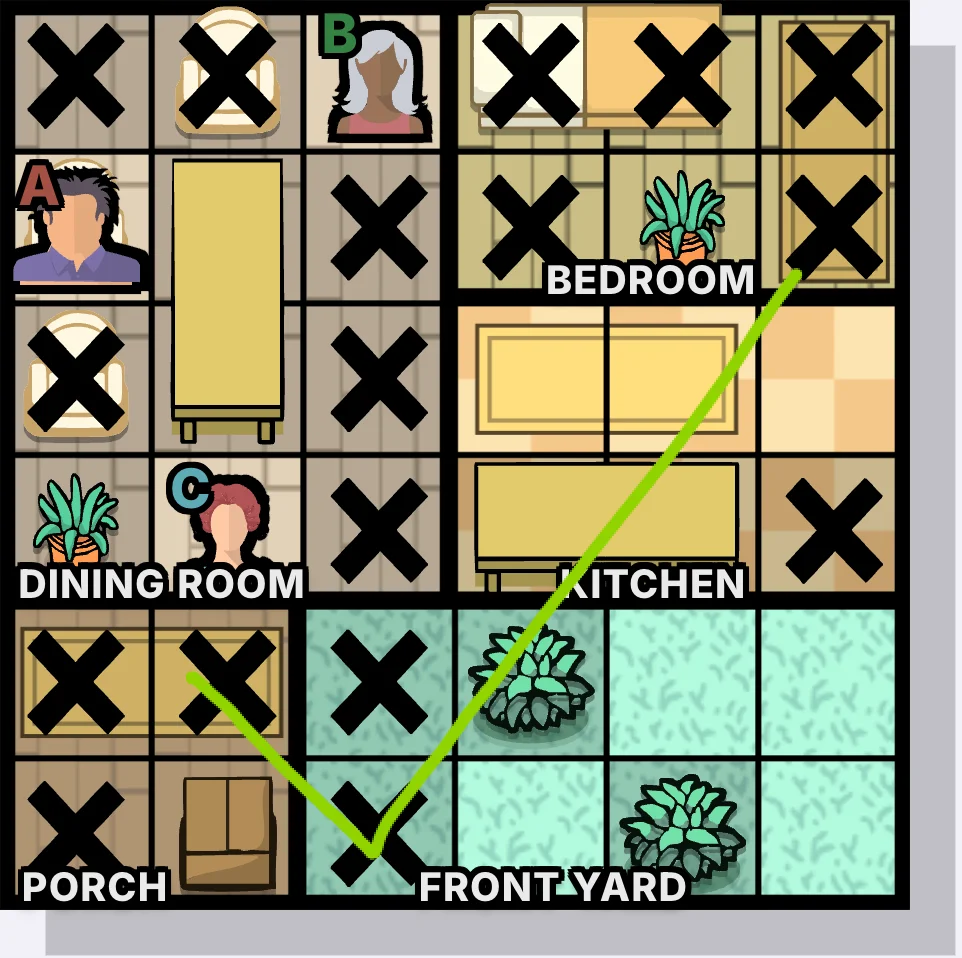
Count legal cells, not printed squares
A six-cell room may have only two legal cells left after occupied rows, occupied columns, object requirements, and X marks are applied. Its useful capacity is therefore two, not six.
- Cross out rows and columns already used by confirmed suspects.
- Remove cells that fail the suspect's own clue.
- Keep candidates separate by suspect; two people may not share the same candidate set.
named region
When an empty room is meaningful
An empty room matters when it frees rows or columns elsewhere, satisfies an explicit empty-region clue, or proves that the victim cannot be there. It is a conclusion, not a default starting rule.
If all legal cells in a region are eliminated for every unresolved suspect, mark the region empty and propagate that information to clues that mention occupancy.
Locked sets create pressure
If two suspects can only occupy the same two legal cells in a region, those cells are locked for the pair. Other suspects cannot use them even though you do not yet know which person takes which cell.
This is the room version of candidate pairing: record the set, then revisit affected rows, columns, and regions.
Room-capacity checklist
- Write the room name and list its cells.
- Remove occupied rows and columns.
- Apply each unresolved suspect's clue separately.
- Compare the number of required suspects with the union of legal cells.
- Propagate locked or empty results; do not force occupancy without evidence.
Common mistakes
- Assuming one suspect per room. The global restriction is one per row and column, not one per region.
- Counting decorative or object cells as legal without checking whether a suspect can stand there.
- Treating a room as empty before testing every unresolved suspect.
Room capacity FAQ
Must every Murdoku room contain a suspect?
No. A room can be empty unless a clue or the combined remaining constraints force occupancy.
Can two suspects be in the same room?
Yes, if their cells satisfy every clue and do not share a row or column. Region-specific clues may add further limits.
When should I use room capacity?
After direct clues and easy row-column eliminations, when several suspects still share a small pool of cells.
Keep learning
Source
Original explanatory diagram by murdoku.fans. The colored block is a generic region, not an official case.