Murdoku candidate logic
Forced Occupancy and Locked Candidates
A placement is forced when every alternative breaks at least one active rule. The force may belong to one suspect, one row or column, or a locked group—not only to a single obvious clue.
- Look for
- One candidate, one location, or a locked set
- Required habit
- Write candidates before placing
- Safety rule
- Name the rule that removes each alternative
Three kinds of force
A suspect is forced when that person has one legal cell. A cell is forced when only one suspect can use it. A group is locked when N suspects are limited to the same N cells.
The third pattern does not tell you the final order, but it immediately excludes every outsider from those cells.
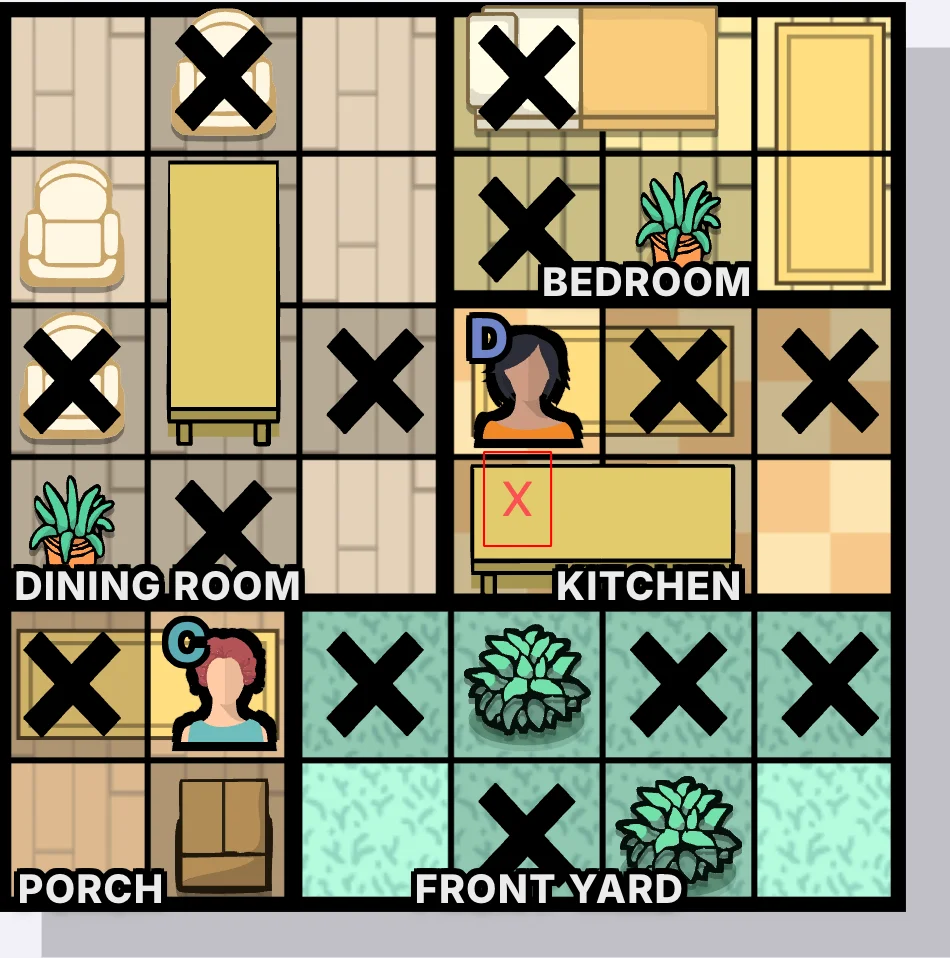
Propagate every confirmed placement
After placing one suspect, cross out the entire row and column for everyone else. Then re-read region, object, and directional clues affected by that cell.
- Update all candidate lists, not only the next card.
- Check for a new single candidate.
- Check whether a row or column now has only one eligible suspect.
Prove before you place
If your reason is merely that a cell looks likely, keep it as a candidate. A sound note looks like: B cannot use C1 because that column is occupied, cannot use C3 because the clue requires south of the plant, therefore C2 is forced.
This short proof trail prevents one early guess from contaminating the whole board.
Forced-placement checklist
- List candidates for every unresolved suspect.
- Apply occupied rows and columns.
- Look for one-cell suspects and one-suspect cells.
- Mark N suspects in N cells as locked, without deciding their order.
- After every placement, update the full board.
Common mistakes
- Treating a candidate pair as a finished placement.
- Updating only one clue after a placement.
- Using trial and error without recording which rule caused a contradiction.
Forced occupancy FAQ
Is forced occupancy an official extra rule?
No. It is a solving technique that combines the normal clue, row, column, and region constraints.
Can I place a suspect from a locked pair?
Not until another constraint distinguishes the two cells. The pair only excludes other suspects.
What if no placement is forced?
Keep candidate sets and search for a row, column, region, or clue shared by a small group.
Keep learning
Source
Original teaching diagram by murdoku.fans; letters and cells are generic.