Solving guide
A practical Murdoku strategy
Good Murdoku solving feels less like guessing and more like bookkeeping. Treat every clue as a filter on the map.
Beginner solving order
Use this order before trying clever deductions. It keeps the board readable and prevents early guesses.
Read every clue first
Check the victim and all suspect cards before placing anyone. Mark clues that name a room, column, or object.
Start with hard constraints
Place or mark candidates for fixed rooms, fixed rows or columns, and unique objects before handling relative clues.
Cross out rows and columns
Every confirmed person removes the rest of that row and column for all other people.
Confirm the murder at the end
Use the victim and murderer condition only after positions settle: the killer is alone with the victim in one area.
Use hover highlights to read clue words
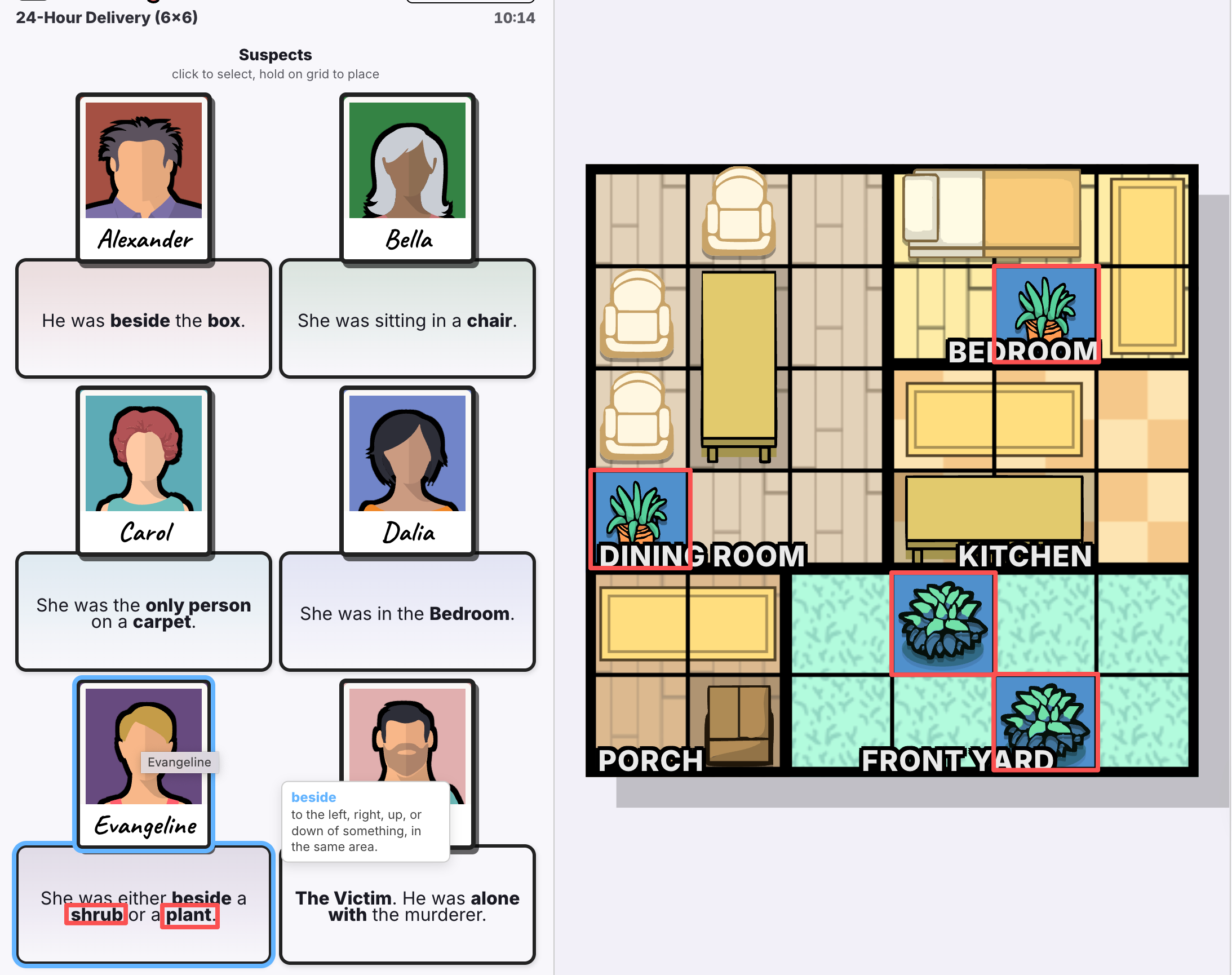
In the official Murdoku interface, move your mouse over a suspect card to preview the clue. The board on the right highlights related keywords and matching objects, such as beside, shrub, plant, room names, or furniture. Use those highlights as a quick way to connect English clue words with the map before you eliminate candidates.
Hover map cells to identify objects
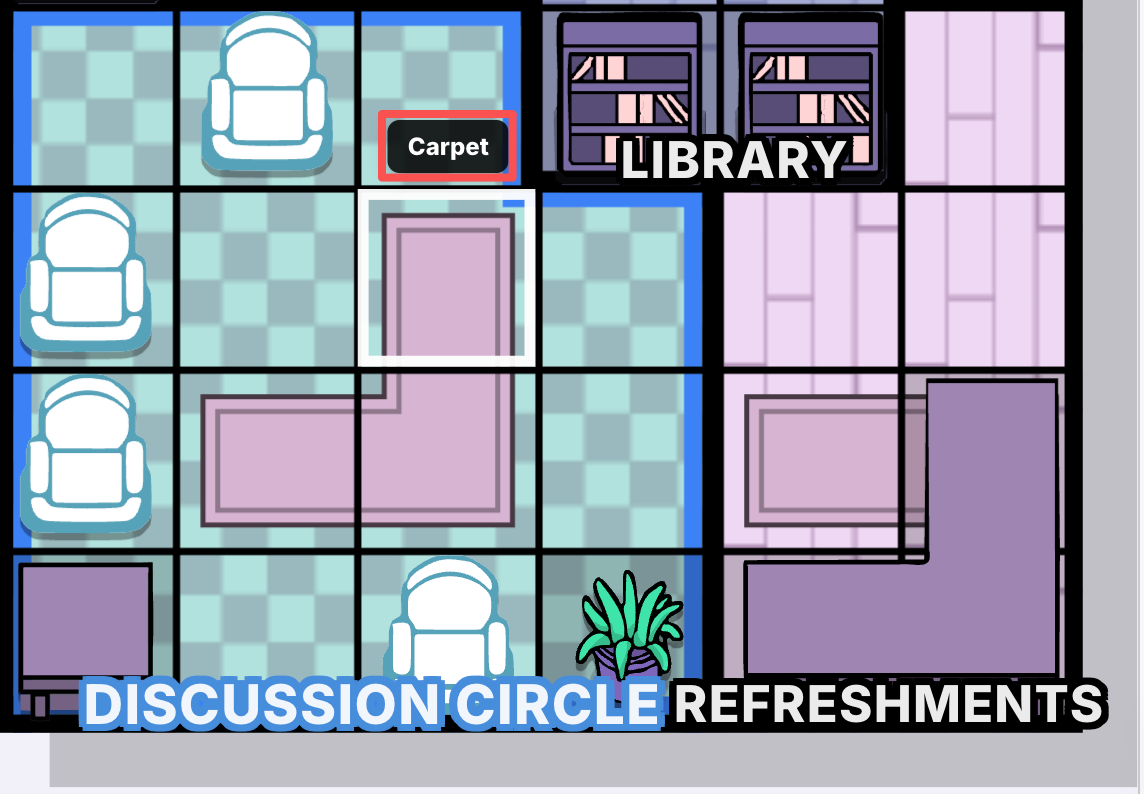
You can also move the mouse over a cell on the case map. If the cell contains an object or floor feature, the official interface shows its name, such as Carpet. This is useful when a clue mentions an object but the icon is not obvious at first glance.
Start with unique objects
Clues about a single chair, a single plant, or one named room usually create the smallest candidate set. Mark those before relational clues.
Convert directions into zones
If a suspect is south of another suspect, remove all cells that are not below the reference. This often becomes powerful once either person has only two or three candidates.
Apply row and column pressure
When one suspect is placed, cross out the rest of that row and column for every other suspect. Many very easy puzzles fall quickly from this rule.
Do not solve the murder too early
Victim clues point to the endgame, but the murderer is usually proven only after positions settle. Use the murder condition as a final consistency check.
Watch area boundaries
Two squares may touch physically but belong to different regions. If a clue says beside a plant or alone in a region, the colored boundary matters.
Go deeper on the step blocking you
The technique library separates room capacity, forced placements, clue wording, and coordinates so you can target the exact step that is blocking you.
Open the technique libraryBuild a broader deduction toolkit
Different mystery grids train different reasoning habits. Use these comparisons to choose what to practise next.