Murdoku clue language
How to Read Murdoku Clue Wording
Most wording mistakes come from silently adding a condition the sentence never states. Translate each clue into a small test: who is constrained, what relation is required, and what scope the qualifier controls.
- First step
- Underline subject, relation, and qualifier
- Scope matters
- Person, row, column, object, or region
- Best defense
- Rewrite the clue as a yes/no test
Separate relation from scope
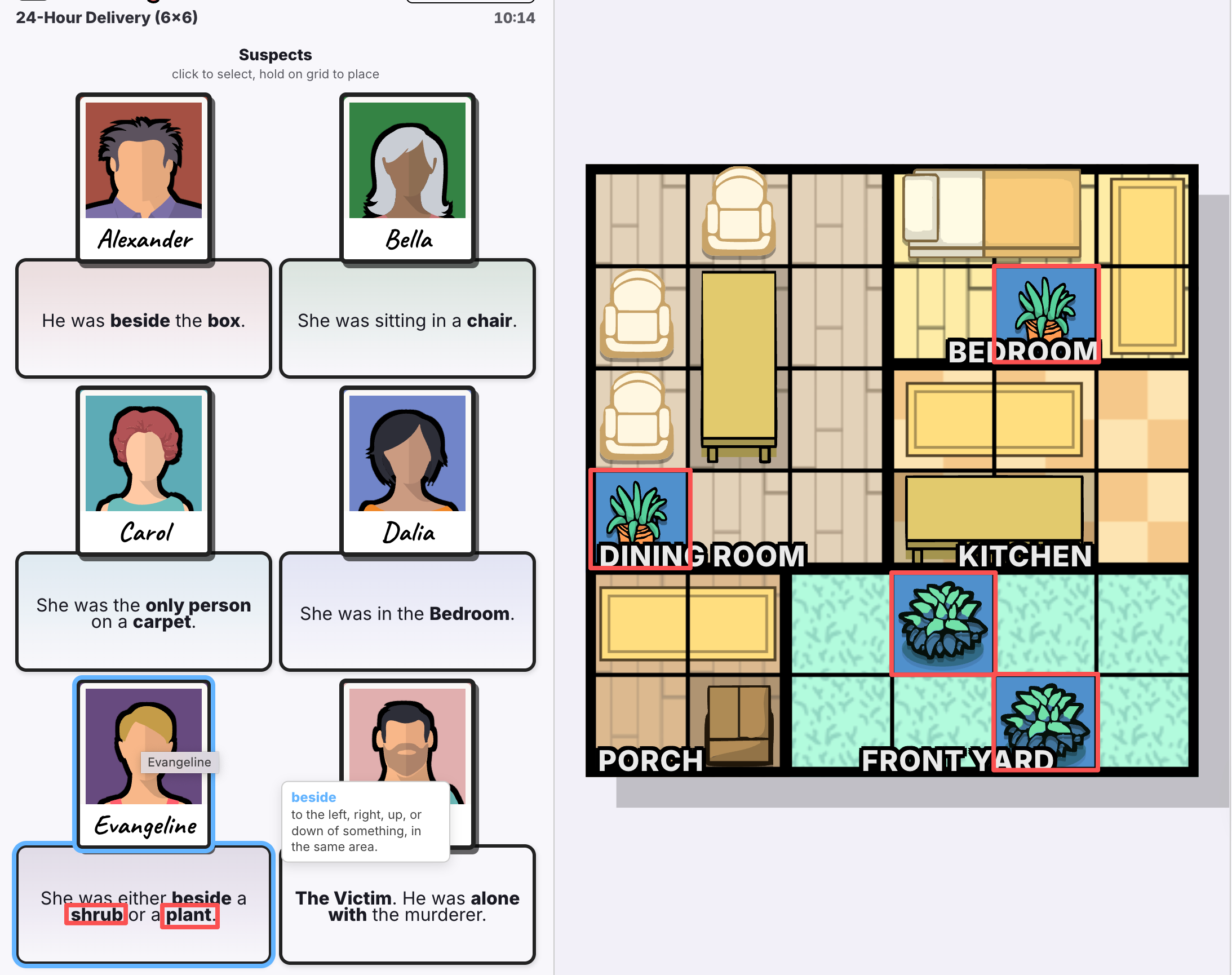
In “A is beside a plant,” beside describes an edge-sharing relation; the exact Murdoku context also requires you to respect region boundaries. It does not mean anywhere near a plant or diagonally touching it.
In “A is south of B,” south describes row order. It does not automatically mean the same column or immediately below.
Quantifiers change the whole clue
Only means every competing match must be excluded. At least one means one or more, not exactly one. Exactly two sets both a minimum and a maximum. Either A or B normally allows the stated alternatives; do not invent a third.
- Circle only, exactly, at least, at most, not, and either/or.
- Ask what noun the qualifier modifies.
- Test the candidate against the literal sentence before using intuition.
Avoid importing everyday meaning
Puzzle language is operational. Words such as with, alone, in, on, and beside refer to board relationships defined by the game, not to a loose real-world scene.
When the official interface offers a hover definition, use that definition for the current puzzle and then record it in your notes.
Clue-reading checklist
- Identify the subject.
- Underline the relation word.
- Circle every qualifier or negation.
- Define the scope: cell, row, column, object, or region.
- Write one test that a candidate must pass.
Common mistakes
- Reading south of as directly below.
- Reading at least one as exactly one.
- Applying only to the wrong noun or region.
- Letting a plausible story override the literal board rule.
Clue wording FAQ
Does beside include diagonals?
In the site's current Murdoku guidance, beside means edge-sharing up, down, left, or right, with the relevant region rule respected; diagonals do not count.
Does south of mean the same column?
No. It means a lower row unless the clue adds a column restriction.
What should I do when a word is unclear?
Use the official interface definition if shown, compare it with the board, and avoid placing until one interpretation is supported.
Keep learning
Source
Original language-to-logic diagram by murdoku.fans; it does not reproduce an official clue set.