Murdoku vs Killer Sudoku
Murdoku vs Killer Sudoku: what is the difference?
The names make them sound close, but they ask you to reason about different things. Murdoku places people on a crime-scene map; Killer Sudoku places digits in a number grid with sum cages.
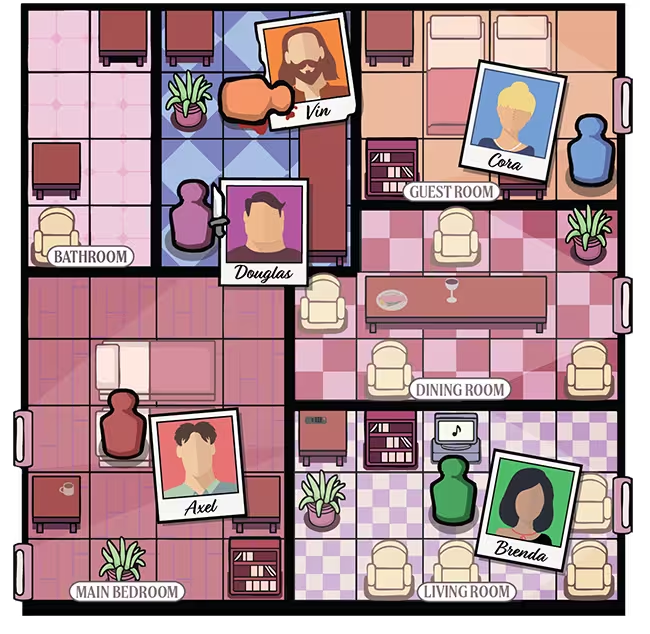
- Murdoku board
- Suspects, rooms, objects, and spatial clues
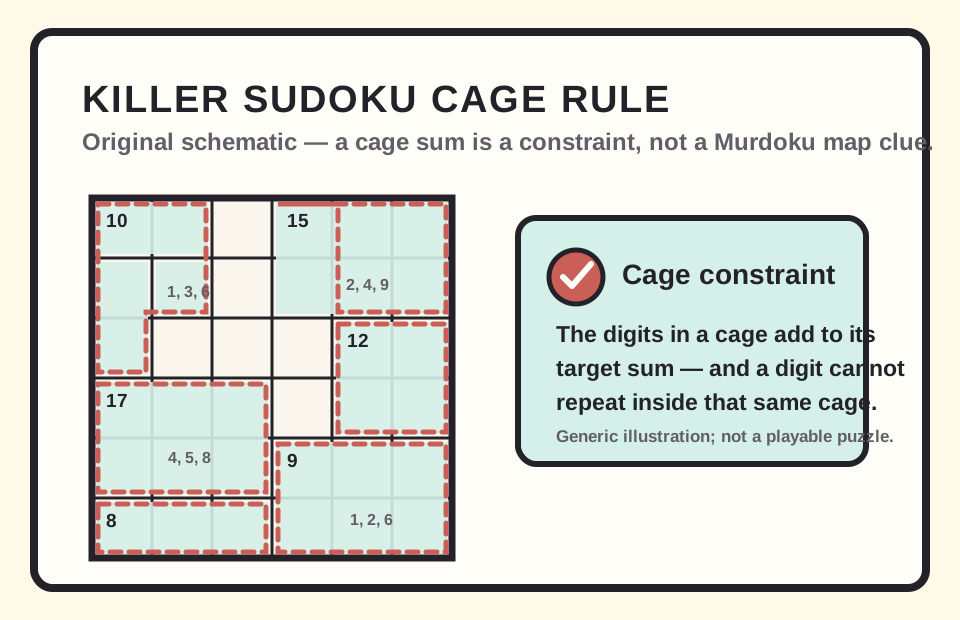
- Killer Sudoku board
- Digits 1–9, 3×3 boxes, and sum cages
- Shared habit
- Use a confirmed placement to remove other candidates
Why the two puzzles are confused
Both games borrow the visual discipline of Sudoku: a placement affects the rest of its row and column. But “murder” means a story objective in Murdoku, while “killer” names a number-based Sudoku variant. One puzzle asks who can stand in a location; the other asks which digit can occupy a cell.
Rules at a glance
The comparison below is an editorial summary of the published rules. It is more useful than comparing a vague difficulty label, because the information each board gives you is fundamentally different.
| Question | Murdoku | Killer Sudoku |
|---|---|---|
| What fills the board? | Named suspects on a crime-scene map | Digits 1–9 in a Sudoku grid |
| Main local clues | Rooms, objects, directions, and relationships | Dashed cages with target sums |
| Core row/column rule | At most one person per row and column | Each digit appears once per row and column |
| Cage-specific rule | No number cages | A digit cannot repeat within one cage |
| Extra structure | Colored areas and the victim/murderer condition | Standard 3×3 boxes and cage arithmetic |
| End goal | Place suspects and identify the murderer | Complete the digit grid consistently |
What transfers from Killer Sudoku
Candidate bookkeeping transfers well. In both formats, a confirmed placement closes options elsewhere, and a small candidate set is usually worth examining first. A careful solver also checks whether a proposed move conflicts with more than one constraint before committing it.
- Keep possibilities separate from confirmed placements.
- Use row and column pressure after every confirmed move.
- Prefer deductions that reduce several candidates at once.
What does not transfer
Killer Sudoku’s arithmetic is not part of Murdoku. Murdoku has no digit sums, no 3×3 number boxes, and no cage combinations to calculate. Conversely, Killer Sudoku does not ask you to interpret a room, an object, or whether a murderer is alone with a victim. Treat the shared grid layout as a familiar interface, not as a shared rulebook.
Which one should you choose?
Choose Murdoku when you want a narrative scene, named characters, and spatial language. Choose Killer Sudoku when you enjoy numeric combinations and sum constraints. If you like both, use Murdoku to practise visual constraint tracking and Killer Sudoku to practise arithmetic candidate control; neither replaces the other.
Murdoku vs Killer Sudoku FAQ
Is Murdoku a type of Killer Sudoku?
No. Murdoku uses a Sudoku-style row-and-column placement idea for suspects and locations; Killer Sudoku is a digit puzzle built around cage sums.
Does Murdoku use cage sums?
No. Murdoku clues describe people, map positions, objects, regions, and the murder condition rather than arithmetic totals.
Does Killer Sudoku experience help with Murdoku?
It can help with candidate tracking and constraint checking, but you still need to learn Murdoku’s spatial vocabulary and area rules.
Which should a new player try first?
Choose the format you find more inviting: story-and-map deduction for Murdoku, or digit-and-sum deduction for Killer Sudoku.
Related logic-puzzle guides
Sources checked
This is an independent rules comparison. Murdoku and Killer Sudoku are separate puzzle formats and properties.