Murdoku creator story
How was Murdoku created? Manuel Garand's path from game prototype to puzzle books
Murdoku did not begin as a book. Manuel Garand first imagined a much larger video game about reconstructing every suspect's movements on the night of a murder. Cutting that idea down to one crime-scene grid revealed the system players know today.
- Creator
- Manuel Garand
- First Murdoku puzzles
- 2020
- Original concept
- Murder-mystery roguelike
Who created Murdoku?
Murdoku was created by Montreal puzzle designer Manuel Garand. Before the books, he spent years prototyping puzzle video games, including an archaeology game inspired by Minesweeper. Those attempts did not become finished products, but they trained him to combine a familiar logic structure with a strong theme.
One influence he names is David Millar's Haunted Mirror Mazes, which places vampires, zombies, and ghosts inside a mirror puzzle. Garand was less interested in copying its rules than in its central lesson: abstract spatial logic can carry a memorable fictional setting.
Murdoku began as a murder-mystery roguelike
Garand's original plan asked players to reconstruct every suspect's location at every hour on the night of a murder. That scope implied timelines, movement histories, and a larger video-game system. It was ambitious, but the complexity hid the core decision the player needed to make.
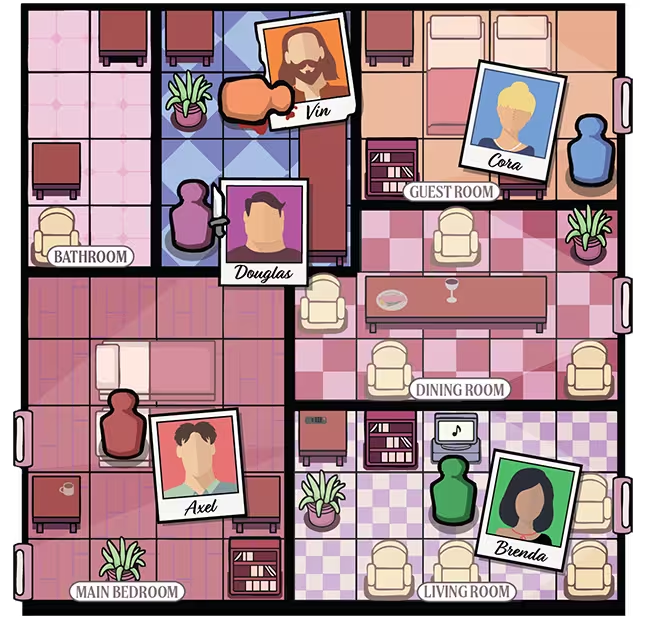
He eventually reduced the project to a 9×9 crime-scene grid made in Photoshop: one person in each row and column, one clue per suspect, and a final question about who shared the victim's area. Garand describes Murdoku as the failed version of the larger dream. In product terms, the failure was useful: subtraction exposed the distinctive play loop.
From free web puzzles to a publisher
Garand made the first Murdoku puzzles in 2020 under the name murder mystery puzzles. After early players responded well, he published free downloadable cases on murdermysterypuzzles.com and built a tool that helped him create and test puzzles faster.
Positive reactions did not produce an immediate book deal. Garand pitched many publishers and literary agents, received only rejections, and left the project for a year. The turning point came when KrazyDad founder Jim Bumgardner found the website and introduced him to Francis Heaney, an editor at Puzzlewright. The site did not guarantee publication; it made a working product easy for the right person to discover and evaluate.
Why full colour belongs to the product
Garand insisted on full-colour printing because he wanted a premium puzzle book inspired by board games, not a conventional black-and-white exercise book. Colour carries information, separates rooms, and gives each crime scene a physical sense of place. The publisher supported that choice despite the higher production cost.
Most character portraits were drawn by Valentyna Bezdushna, who has worked on the project from the beginning. Garand also drew on his family for characters; his sister Ariel appears on the back cover holding a French bulldog. These details make the book feel inhabited without changing the underlying logic.
How a Murdoku puzzle is designed
A puzzle usually starts with a location and one key logical relationship. Garand then adds deductions before and after that relationship until the chain can support a complete case. Repeated construction, testing, and revision matter more than a fixed formula.
The map must also make visual sense. A living room should still read as a living room, with plausible furniture and objects, even though every element also affects clue interpretation. Murdoku therefore joins two design problems: a valid deduction chain and a legible crime scene.
Player behaviour changed the later books
Puzzlewright editor Francis Heaney suggested the note grids added late in Book 1. Garand expected readers to write directly on the main grid, but readers relied heavily on the notes. Volume 2 then made occupied cells easier to mark, turning observed player behaviour into a concrete interface improvement.
Much of Volume 2 was complete before Volume 1 reached readers. Garand therefore describes Volume 3 as the first book able to absorb more of their feedback, including clearer clue wording and a smoother difficulty curve. Expansion works best here when it strengthens the base interaction before adding novelty.
What Volumes 3 and 4 add
In the interview, Garand says Murdoku Volume 3: Around the World is planned for October 27, 2026 with 80 locations. Some cases introduce multiple crime scenes, so players must determine both a suspect's position and which scene contains that suspect.
He names Volume 4 Beyond the Grave and describes it as horror-themed, with publication planned for 2027. These are dated plans stated in the August 2026 interview, not permanent availability promises; check the publisher before ordering.
What Murdoku's evolution actually shows
The useful lesson is not simply that a free website leads to a publisher. Garand's pitches were rejected, and discovery depended on a chance connection. The stronger pattern is complex concept → smaller playable core → repeatable production tool → public artefact → external champion.
Each step made the idea easier to inspect. The 9×9 grid clarified the game, the tool made iteration cheaper, the website let strangers try it, and full-colour production signalled that the final object belonged closer to a board game than a worksheet. Murdoku grew by protecting its core spatial deduction while changing its themes, notation, and scale around that core.
Murdoku creator FAQ
Who created Murdoku?
Montreal puzzle designer Manuel Garand created Murdoku.
When was Murdoku created?
Garand made his first Murdoku puzzles in 2020, then published free downloadable puzzles on a website.
Was Murdoku originally a video game?
It grew from an unrealized murder-mystery roguelike concept about reconstructing every suspect's movements across the night of a murder.
What comes after Murdoku Volume 2?
The August 2026 interview names Volume 3: Around the World and Volume 4: Beyond the Grave. Release plans can change, so verify current publisher listings.
Continue exploring Murdoku
Sources checked
This independent guide paraphrases the interview and adds analysis. It does not reproduce the full question-and-answer text. Book plans and dates may change.